Preparing Students for a World with AI
November 4, 2025

Dear Families,
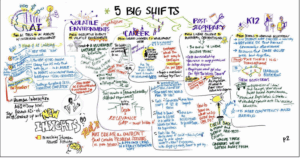
In August, the Keys Leadership Team stepped away from our campuses for a two and a half day off-site retreat to imagine the future our students will inherit – a future defined by exponential technological change and deep uncertainty. We gathered with education futurist Andrea Saveri, whose work helps educational leaders use “strategic foresight” to anticipate the forces shaping the decade ahead. We were fortunate also to have the talented Graphic Recorder, Leslie Salmon-Zhu, present to visually record our discussion as seen in the images below. Our goal was not to predict the future but to prepare for it – to ask what will truly matter for our students during a time when artificial intelligence is transforming how we live, work, and learn.
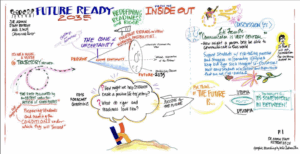
As Andrea reminded us, the half-life of many technical skills is now less than four years. The world our graduates will enter will be less about climbing a “career ladder” and more about moving through networks–of people, projects, and machines. Work will become more fluid, driven by “workflows” rather than job titles. Post-secondary education will diversify pathways of credentialing, apprenticeships, and continuous learning. And the climate, political, and social “polycrisis” shaping our children’s generation will require adaptability, empathy, and courage.
While in session, Andrea posed two questions: What will our students need to navigate the future, and how do we help them thrive in it?
“Across each imagined future, one theme was constant: human connection was the differentiator.”
Through guided activities, the leadership team explored five global drivers of change – from the acceleration of AI to the fragmentation of K-12 education and the rise of “mosaic” careers. This discussion led us to imagine vignettes of “Keys graduates from the future” – fictional but possible portraits of alumni in 2035 or 2040.
One was a high schooler collaborating with peers and an AI guide to monitor stormwater runoff during a prolonged heatwave. Another was a 27-year-old “workflow designer” helping teams and machines collaborate effectively. Others included apprentices reimagining food systems, clinical care coordinators using emotional intelligence to guide complex decisions with virtual support from agents, and entrepreneurs blending art, science, and social purpose.
Across each imagined future, one theme was constant: human connection was the differentiator. The grads who thrived were not those who knew the most about AI, but the individuals who knew the most about themselves and others. Those individuals could collaborate across cultures and technologies; they could listen across difference. These graduates were reflective, resilient, and grounded in a moral compass. In short, they were deeply human.
“This belief–being human is not a soft skill but a core competency–is at the heart of a Keys education.”
This belief – that being human is not a soft skill but a core competency – is at the heart of a Keys education. Our mission has always centered on knowing and being known, listening and being heard. Social-emotional literacy, inclusion, and justice are not side lessons: they are the foundation for intellectual growth and strong leadership.
As author and editor of two AI education books, Stefan Bauschard noted in his 2023 essay Caring Will Soon Be the #1 Job Skill, the greatest value people can bring in an age of automation is “to supply our humanity.” Machines may outthink us in speed and precision, but they cannot yet feel empathy, build trust, or discern what is right. Bauschard argues that learning to care is not simply a virtue – it is a survival skill in a world where the meaning of human work itself is being redefined.
“…the skills most essential for the future are the ones we hold sacred today.”
Our time with Andrea strengthened our conviction that the skills most essential for the future are the ones we, at Keys, already hold sacred today. Students who can navigate ambiguity, self-regulate, ask profound questions, listen, and collaborate across differences, and build inclusive communities will be ready not only to succeed but also use their agency to shape a more just and compassionate world.
The task before us as educators is to evolve continually–integrating new tools like AI thoughtfully and intentionally while holding fast to our deepest values. The question is not simply what we will allow our students to do with AI, but what they will imagine they can do – with courage, integrity, empathy, and purpose guiding every step.
At Keys, that is our commitment: to help our students grow not just as thinkers and innovators, but as humans who know how to care, connect, and contribute meaningfully in a future we can’t yet see – but are preparing for together.
All the best,
Heather